Coal has powered homes, industries, and economies for centuries. While many people refer to coal as a single resource, there are 4 types of coal, each with unique properties, energy content, and real-world uses. Understanding the 4 types of coal is essential for anyone studying energy production, geology, history, or environmental science.
In this in-depth guide, we’ll break down the 4 types of coal, explain how they form, compare their characteristics, and explore where and why each type is used.
What Is Coal?
Coal is a combustible sedimentary rock formed from ancient plant material that accumulated in swampy environments millions of years ago. Over time, heat and pressure transformed this organic matter into coal through a process known as coalification.
The degree of coalification determines which of the 4 types of coal is produced.
Why Understanding the 4 Types of Coal Matters
Knowing the 4 types of coal helps explain:
-
Differences in energy output (BTUs)
-
Pollution and emissions levels
-
Industrial and residential applications
-
Environmental and economic impacts
-
Historical and modern energy choices
Each type of coal plays a different role in global energy systems.
Overview of the 4 Types of Coal
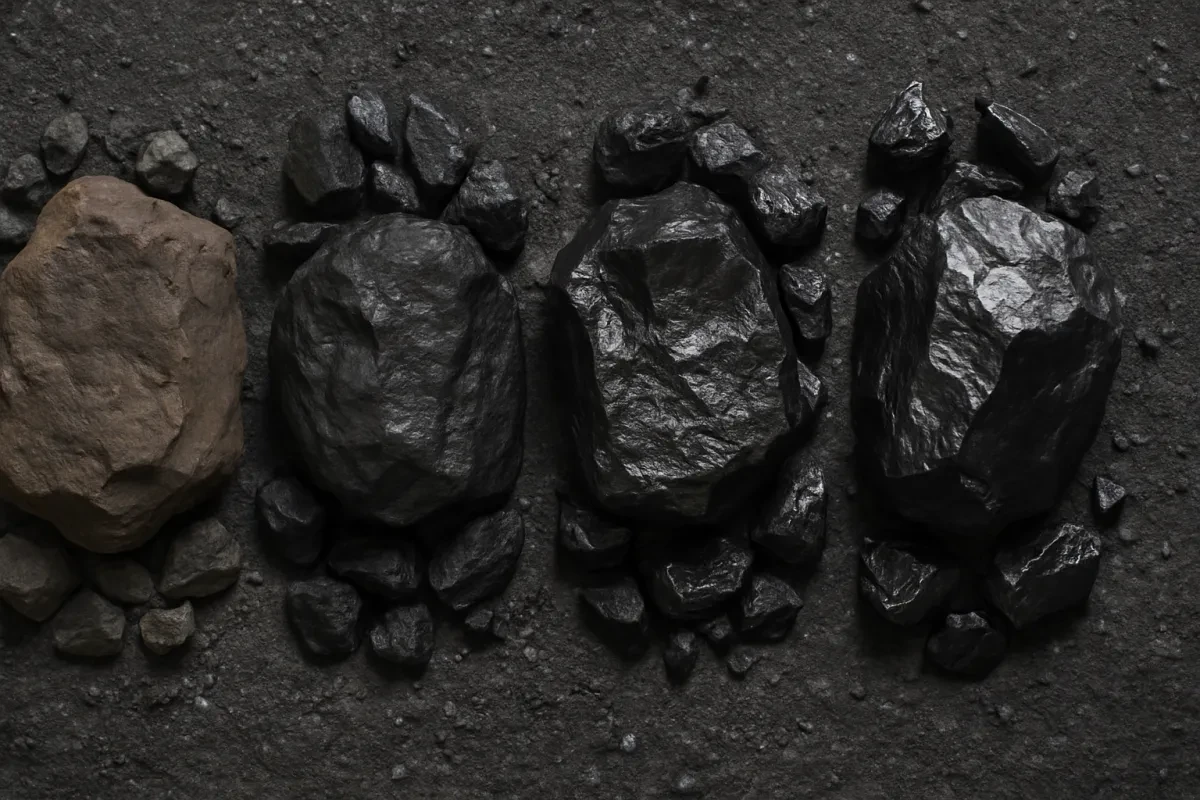
The 4 types of coal, ranked from highest to lowest carbon content and energy value, are:
-
Anthracite
-
Bituminous
-
Subbituminous
-
Lignite
Let’s examine each one in detail.
1. Anthracite Coal (Highest Rank of the 4 Types of Coal)
Anthracite is the highest-quality and most carbon-dense of the 4 types of coal.
Key Characteristics of Anthracite Coal
-
Carbon content: ~86–97%
-
Hard, dense, and shiny black appearance
-
Burns hot and clean
-
Very low moisture and volatile matter
Uses of Anthracite Coal
-
Residential heating
-
Water filtration
-
Metallurgical processes
-
Specialized industrial heating
Advantages
-
Highest energy content
-
Produces minimal smoke and soot
-
Long burn time
Disadvantages
-
Rare and expensive
-
Difficult to ignite
-
Limited global availability
Anthracite makes up a very small percentage of global coal reserves but remains one of the most valuable among the 4 types of coal.
2. Bituminous Coal (Most Common of the 4 Types of Coal)
Bituminous coal is the most widely used and abundant among the 4 types of coal.
Key Characteristics of Bituminous Coal
-
Carbon content: ~45–86%
-
Soft to medium hardness
-
Black, sometimes banded appearance
-
Moderate moisture content
Uses of Bituminous Coal
-
Electricity generation
-
Steel production (coking coal)
-
Cement manufacturing
-
Industrial boilers
Advantages
-
High energy output
-
Widely available
-
Versatile industrial applications
Disadvantages
-
Higher sulfur content
-
Produces more emissions than higher-rank coal
-
Requires pollution controls
When people think of coal power plants, they are usually referring to bituminous coal—making it one of the most economically significant of the 4 types of coal.
3. Subbituminous Coal (Cleaner-Burning Among the 4 Types of Coal)
Subbituminous coal ranks below bituminous but above lignite in the 4 types of coal classification.
Key Characteristics of Subbituminous Coal
-
Carbon content: ~35–45%
-
Dull black appearance
-
Higher moisture content
-
Lower sulfur levels
Uses of Subbituminous Coal
-
Electric power generation
-
Industrial fuel
-
Steam boilers
Advantages
-
Lower sulfur emissions
-
Cheaper than bituminous coal
-
Cleaner burn relative to other lower ranks
Disadvantages
-
Lower energy density
-
Higher transportation costs due to moisture
-
Less efficient than higher-rank coal
Subbituminous coal is often chosen when emissions standards are a concern, making it increasingly important among the 4 types of coal.
4. Lignite Coal (Lowest Rank of the 4 Types of Coal)
Lignite, also known as brown coal, is the lowest grade among the 4 types of coal.
Key Characteristics of Lignite Coal
-
Carbon content: ~25–35%
-
Brownish color
-
Very high moisture content
-
Soft and crumbly texture
Uses of Lignite Coal
-
Local electricity generation
-
Industrial heat near mining sites
Advantages
-
Abundant and inexpensive
-
Easy to mine
-
Useful for regional power plants
Disadvantages
-
Lowest energy output
-
Highest emissions
-
Poor transport efficiency
Due to its limitations, lignite is usually consumed near where it is mined and is the least desirable of the 4 types of coal for large-scale energy export.
Comparison Table: 4 Types of Coal at a Glance
| Coal Type | Carbon Content | Energy Output | Moisture | Common Uses |
|---|---|---|---|---|
| Anthracite | Very High | Very High | Very Low | Heating, filtration |
| Bituminous | High | High | Moderate | Power, steel |
| Subbituminous | Medium | Medium | High | Electricity |
| Lignite | Low | Low | Very High | Local power |
This comparison highlights why understanding the 4 types of coal is essential when choosing fuel sources.
Environmental Impact of the 4 Types of Coal
Each of the 4 types of coal affects the environment differently:
-
Higher carbon coal releases more energy but less waste per unit
-
Lower rank coal produces more CO₂ per unit of energy
-
Sulfur and mercury levels vary by coal type
-
Modern technologies can reduce emissions but increase costs
As energy policies evolve, the role of the 4 types of coal continues to change.
Future of the 4 Types of Coal
While renewable energy is growing, the 4 types of coal still play a role in global energy production. Advances in cleaner coal technologies, carbon capture, and emissions controls may extend their use—especially for higher-rank coal with better efficiency.
Understanding the 4 types of coal also provides insight into historical energy development and future transitions.
Final Thoughts on the 4 Types of Coal
The 4 types of coal—anthracite, bituminous, subbituminous, and lignite—represent different stages of geological transformation and energy potential. Each has distinct advantages, limitations, and uses.
Whether you’re researching energy resources, studying geology, or writing about industrial history, knowing the 4 types of coal gives you a clearer picture of how this vital resource has shaped—and continues to shape—the modern world.